The Unified Patient Claim Journey An open-source framework for standardising the Indian health insurance claim experience.
Every health insurance claim in India follows the same 12-step journey — but no one tells the patient that. UPCJ writes it down.
The problem
Every year, millions of Indian patients and their families navigate health insurance claims with zero standardised guidance. The process involves 6 actors, 12+ handoff points, and two fundamentally different settlement paths — yet no hospital, insurer, or regulator provides a unified map of this journey.
The result:
- Patients don't know what documents to collect, when to collect them, or who is responsible for what.
- Caregivers are forced to learn the system under extreme stress, often discovering critical steps too late.
- Claims get rejected not because of medical invalidity, but because of process failures — missed deadlines, unsigned forms, missing original documents.
- Information asymmetry means the patient is always the least informed actor in a six-party system.
The core insight: claim rejections are overwhelmingly process failures, not medical ones. A framework that makes the process legible fixes most of the damage before it happens.
What UPCJ is
UPCJ is a process framework — not software — that defines four things:
- The Universal Journey Map. Every health insurance claim in India, regardless of insurer, TPA, or hospital, follows the same 3-phase, 12-step structural flow. UPCJ codifies this.
- The Ownership Matrix. A RACI-style responsibility map that makes explicit who Owns, Executes, is Consulted, and is Informed at every step — for every actor.
- The Patient Companion Checklist. A practical, phase-by-phase checklist that patients and caregivers can follow in real-time during hospitalisation.
- The Document Registry. A canonical list of every document generated, who generates it, who needs it, and when.
The three phases
The journey is structurally identical for every patient up to a single decision junction — from there, two parallel paths converge again at discharge.
Common entry — diagnosis
- OPD consultation
- Diagnostic workup
- Admission advice
Cashless
- Pre-auth filing
- Query loop
- Pre-auth approval
- IPD treatment
- Enhancement requests
Reimbursement
- Upfront payment
- IPD treatment
- Records collection
- Claim submission
- Query loop
Post-discharge & settlement
- Discharge summary
- Claim adjudication
- Post-hospitalisation recovery
- Final settlement
See the interactive journey map for the full detail at every step, including document handoffs and RACI assignments.
The six actors
Every claim involves the same six actors, in the same structural relationships. Naming them explicitly is the first step to holding each accountable.
| Actor | Role | Primary responsibility |
|---|---|---|
| Patient | Policyholder | Initiates journey, provides consent, funds (reimbursement), files paperwork. |
| Doctor | Clinical owner | Medical decisions, admission advice, treatment, discharge. |
| Hospital | Service provider | Diagnostics, IPD care, pre-auth filing (cashless), billing. |
| Managed Care | Support & coordination | Assists with paperwork, coordinates between patient and TPA. |
| TPA | Claims administrator | Pre-authorisation, query management, claim adjudication. |
| Insurer | Financial risk bearer | Final approval, settlement disbursement. |
Who should adopt UPCJ
- Hospitals — display the journey map at admission desks and insurance counters.
- Insurers & TPAs — include the patient checklist with policy documents.
- Managed Care providers — use as onboarding material for new policyholders.
- Health-tech startups — build digital tools on top of the framework.
- Patient advocacy groups — distribute the checklist as a public good.
- IRDAI / regulators — consider as a basis for standardised patient communication.
Design principles
Every design decision optimises for the least informed actor in the system.
Works across all Indian insurers, TPAs, and hospital types.
Core checklist must work without internet — printable and PWA-friendly.
Framework is language-agnostic; translations are first-class, not afterthoughts.
Describes the process, does not mandate specific forms or systems.
CC BY-SA 4.0. Anyone can use, modify, and redistribute.
Starter kit
The starter-kit/ directory generates a 37-page printable A4 patient companion
from framework/document-registry.json and authored markdown. A tagged PDF is
attached to each starter-kit-v* release.
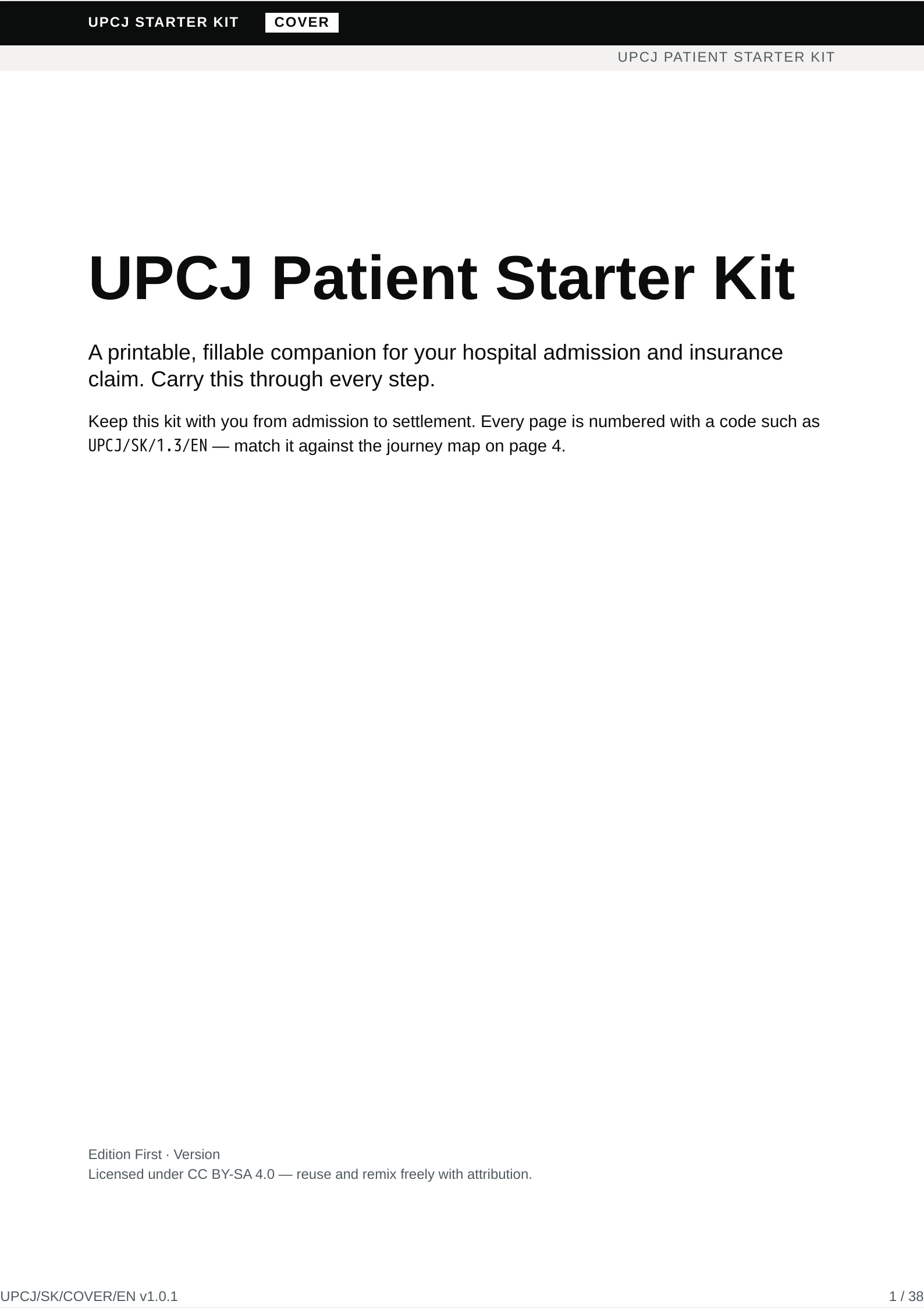
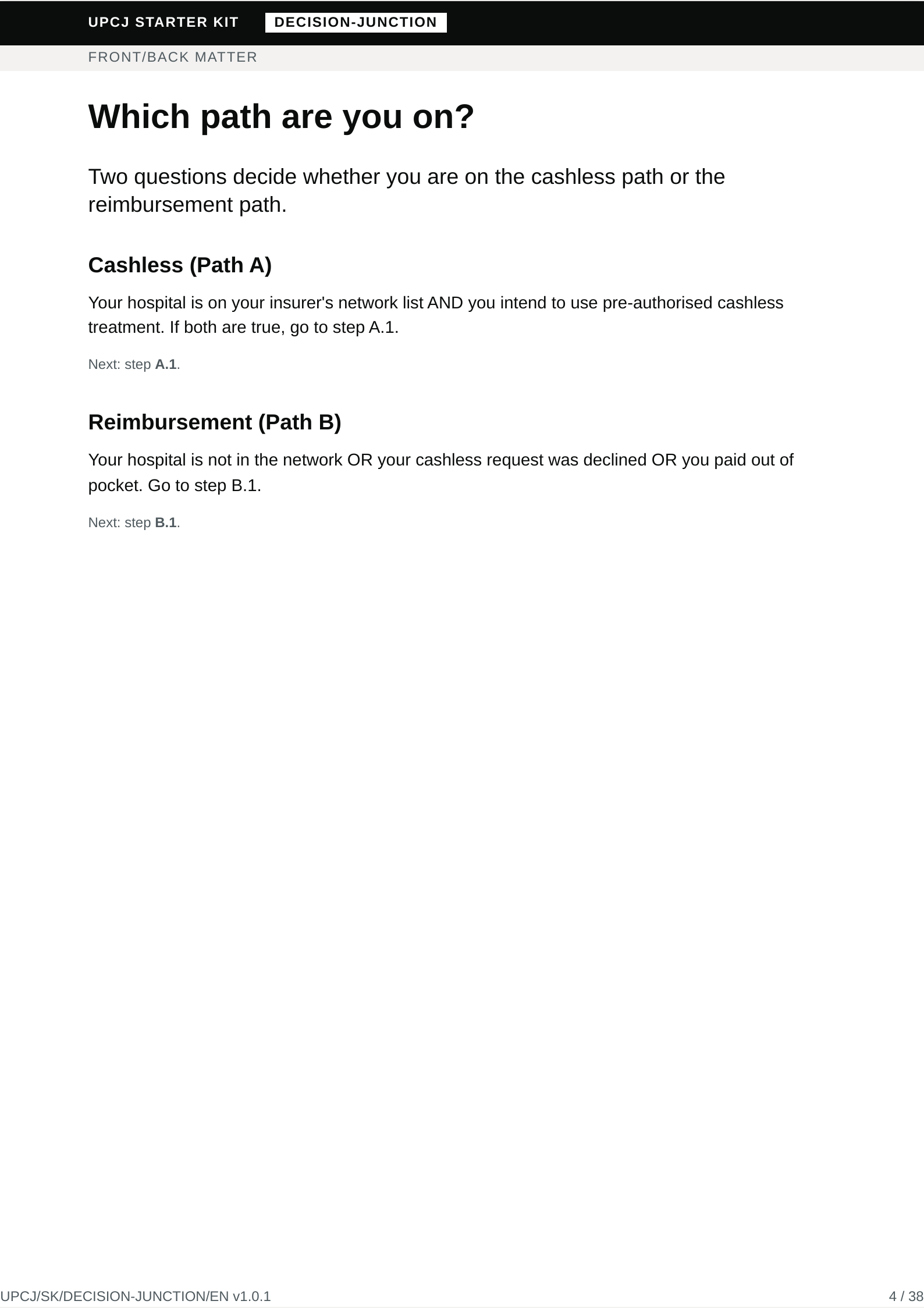
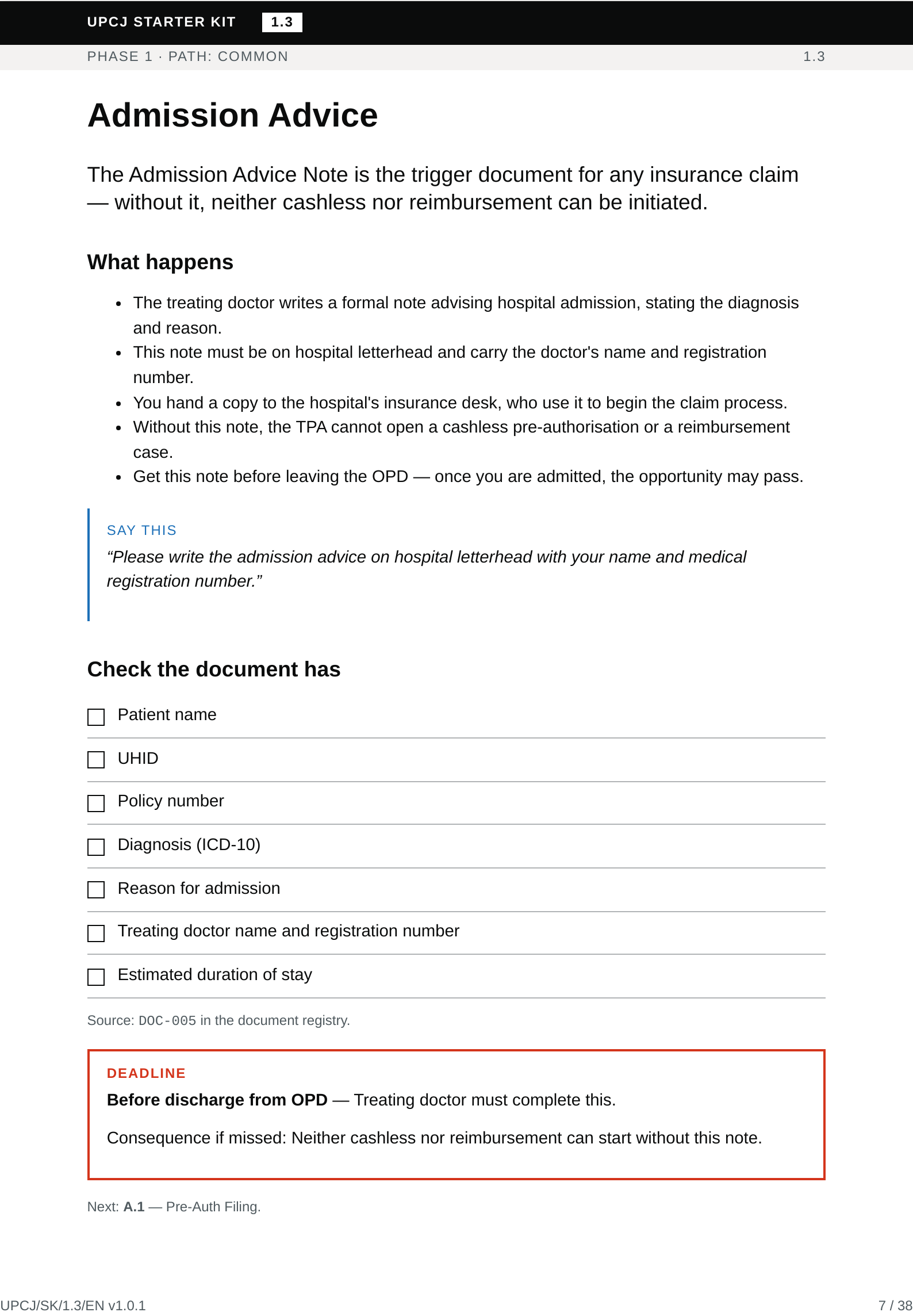
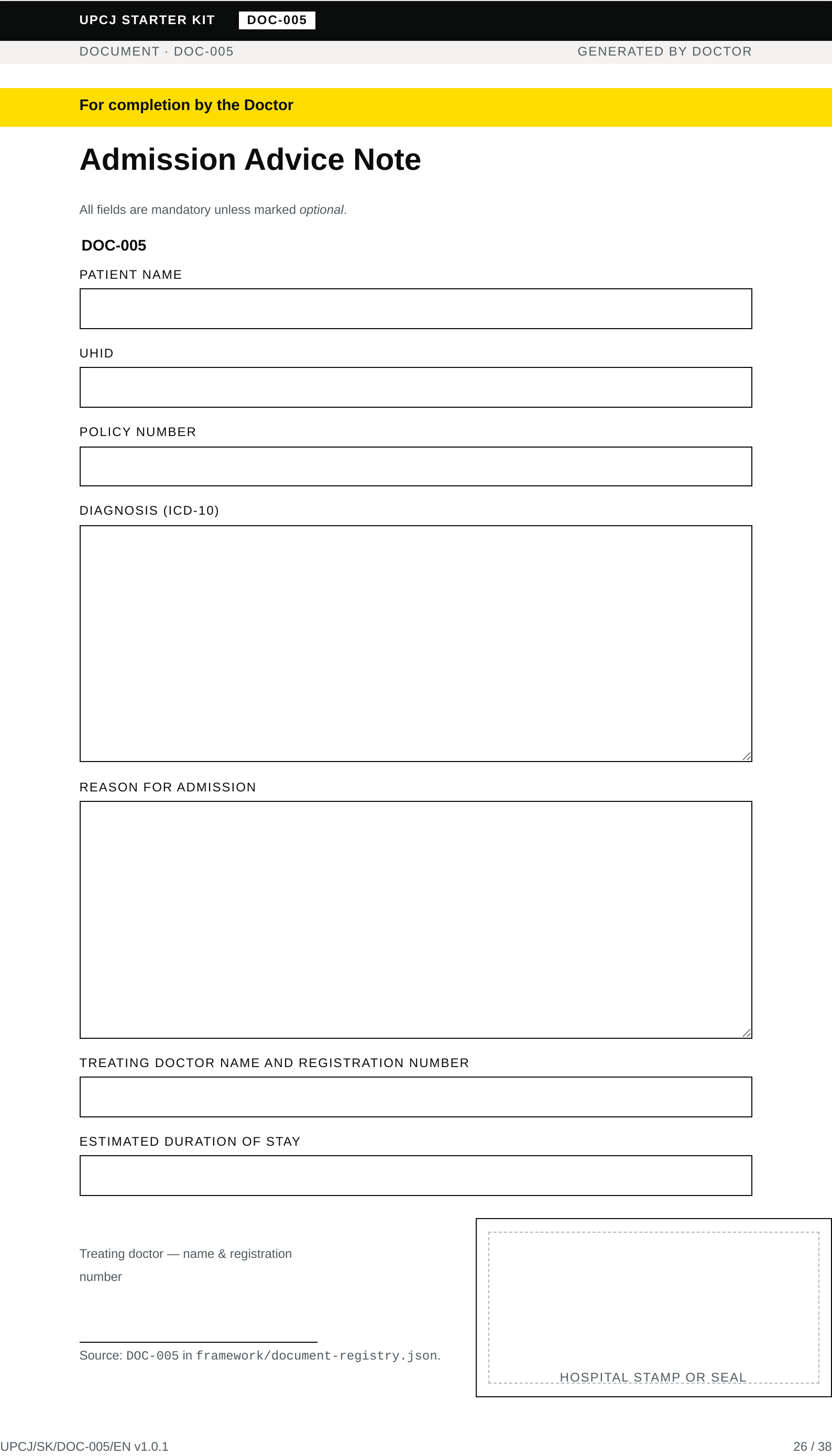
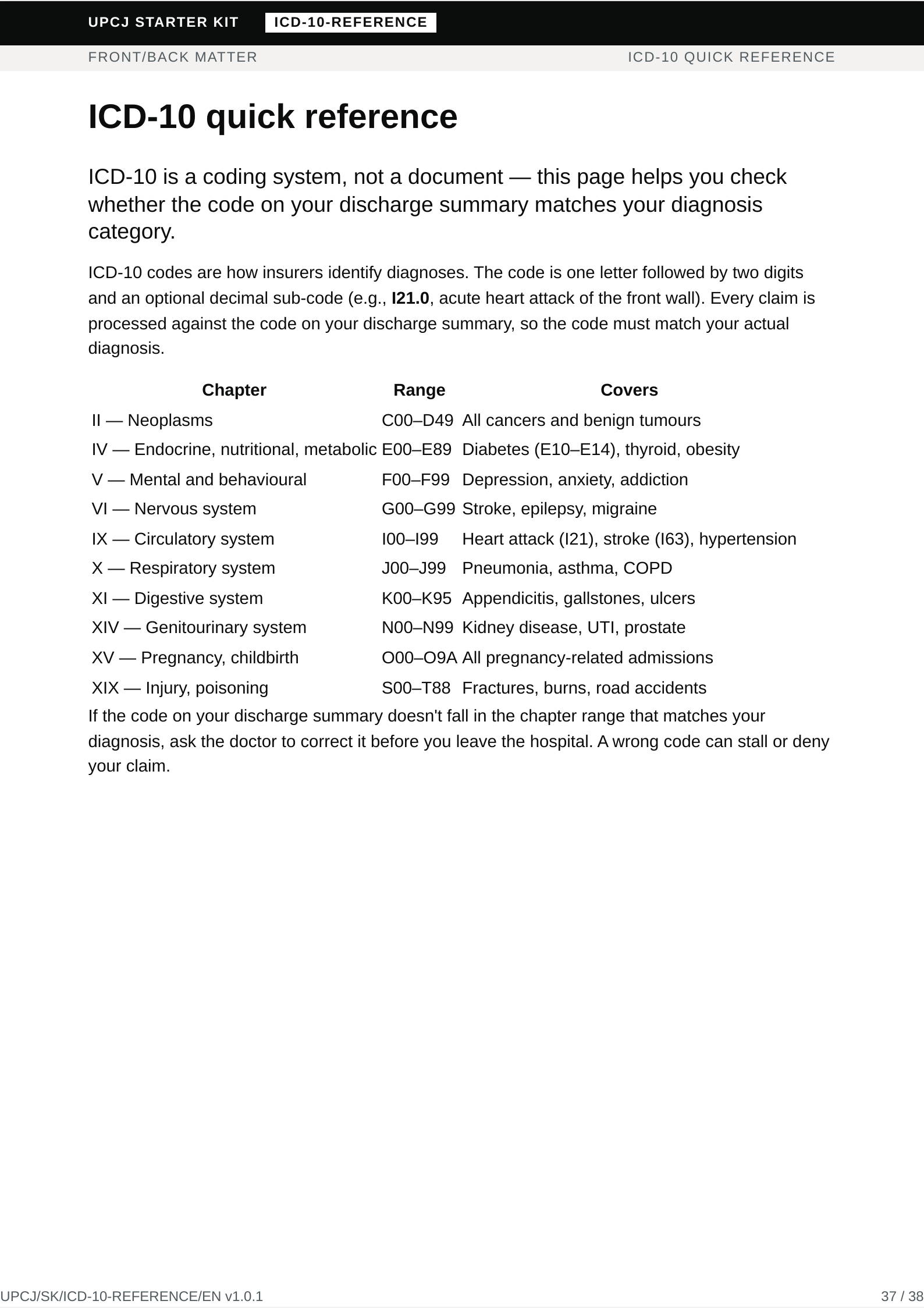
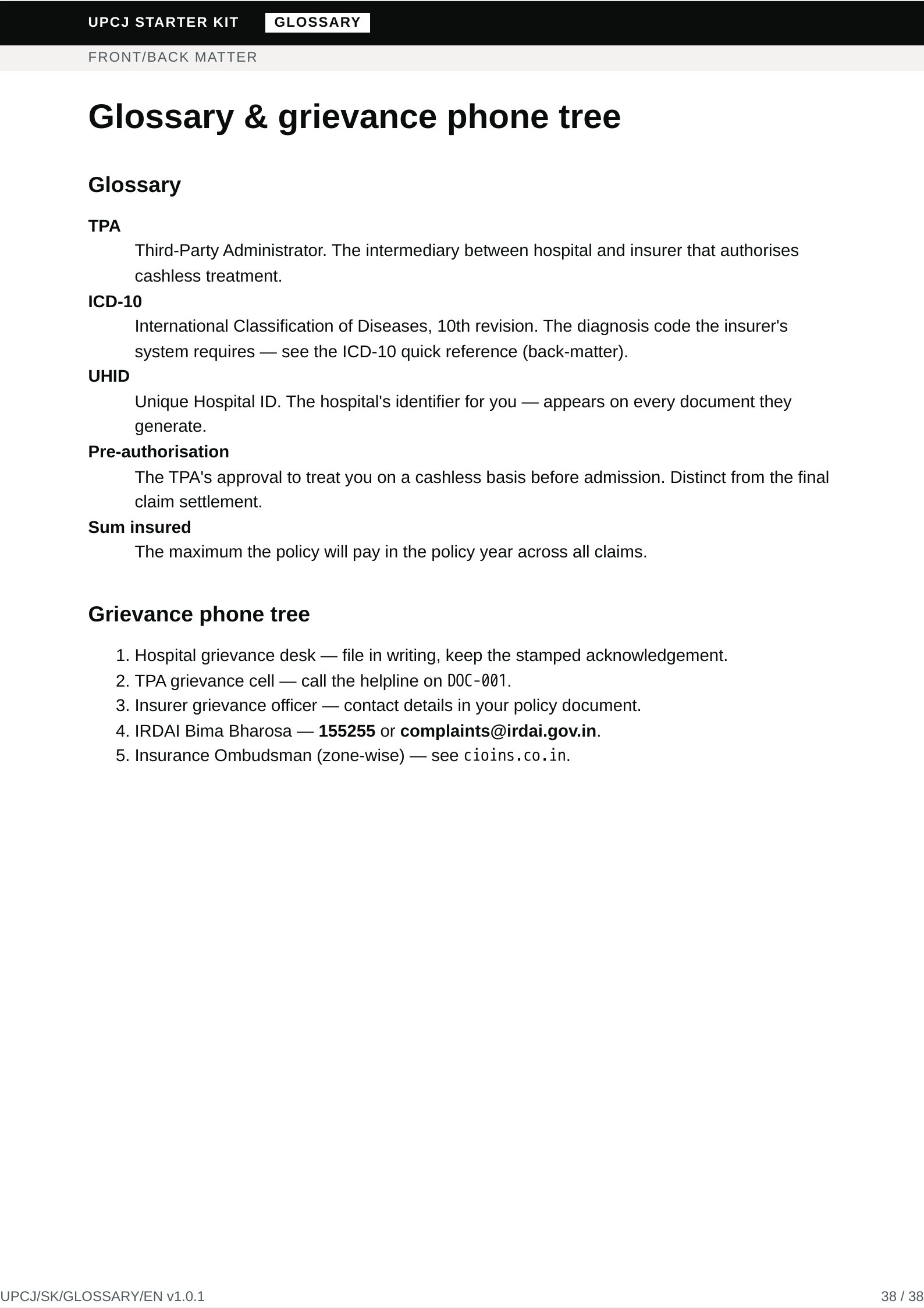
- Print-ready PDF — 37 A4 pages, PDF/UA-1 tagged, CC BY-SA 4.0.
- Authoring guide — how to add a new step or document; how to build and preview locally.
- Kit source — markdown content, build scripts, and Puppeteer PDF renderer.
A fillable AcroForm variant is planned for v1.1. The HTML preview is generated at build time — run cd starter-kit && npm install && npm run build && npm run preview locally.
Core ontology + reference engine
The spec/ directory is the machine-canonical UPCJ — JSON Schemas, state-machine lifecycles, and SLA/event registries that any language can read. engine/ is the TypeScript reference implementation, published on npm so JS adopters get correct behaviour out of the box.
-
@upcj/engine on npm
—
npm install @upcj/engine. Five pure functions (validate, advance, replay, evaluateSLAs, getSpecHash). 79 tests, OIDC trusted publishing. - Engine README — quick start, public surface, develop instructions.
- Spec design doc — architecture, conventions, conformance contract.
- Spec files — 12 schemas, 3 lifecycles, 3 registries, 44 conformance fixtures. The cross-language contract.
Non-JS adopters skip the npm package and read the spec from raw GitHub URLs. The 44 conformance fixtures define the contract every conformant implementation must satisfy — port the engine in any language and prove correctness against the same JSON triples.
For policy and adoption conversations: a 2-page overview suitable for IRDAI, Bima Sugam, patient-advocacy organisations, and hospital/TPA leadership is available at UPCJ-overview.pdf (also on GitHub as markdown).
How to contribute
UPCJ is an open framework. Contributions are welcome in any of these areas:
- Translations — help reach patients in every Indian language.
- Validation — if you work in health insurance (hospital admin, TPA, insurer), improve the journey map.
- Design — improve the visual assets, create print-ready materials.
- Integration — build bots, widgets, or apps on top of the framework.
- Patient stories — share real-world experiences that reveal gaps.
Read the contribution guidelines and open an issue or pull request on GitHub.
License
This work is licensed under Creative Commons Attribution-ShareAlike 4.0 International. You are free to share and adapt it for any purpose — including commercial use — as long as you give appropriate credit and distribute your contributions under the same license.
CC BY-SA 4.0